
What a Government Interview from 1838 Taught Me About My Family
Gichigami, Adaawaagan, & The Beautiful Bird 🛶🦫🌲🪶
The thing I love most about this project, the Pre-AC part of True Story, is that I always end up surprised and amazed at the unpredictability of it all. So many of the ancestor chapters that I previously assumed were going to be boring or tedious to research + write about have unexpectedly ended up being some of the most fascinating portals into my family’s history.
Case in point: I’ve been procrastinating on writing this chapter for the past couple of weeks. When I was doing the bulk of my research last summer, Clara’s mother, Great-Great Grandmother Mary, and her ancestry was one of the pathways I found to be fairly confusing; and, like I do with most confusing things, I recorded some simple notes and then put it away, telling myself I would figure it all out later.
Yeah, it’s a really fun, non-stressful way to live!
I knew that Mary’s ancestors were where we were supposed to have some Ojibwe ancestry, but I was confused about where exactly that came from. Here’s a text that I sent to my mom last week:
“I have some questions about Mary and her mom Sophia and her grandma Angeline…I’m confused because unless Angeline’s parents got Americanized/Christian names, I can’t tell where the Ojibwe ancestry comes from. Angeline’s mom was Scottish, I think, and her dad’s name was Alexander Blair?”
(sidenote: There are conflicting records on whether Angeline or Angelique is my great-great-great-great grandmother’s birth name. I think Angelique may have been what her mother called her, but Angeline is how her children knew her, and that’s the name that’s listed on her gravesite. We’ll talk about this more when we get to it, but I actually have a theory that Angelique may have been the name her father gave her, and so changing it to Angeline might have been a later act of rebellion towards him. So, to honor that theory and reduce confusion in later chapters, we’ll go with Angeline, except when it’s cited as Angelique in certain interviews or articles.)
In the records I had found, Angeline’s mom was listed at Margaret Massay Blair and her father as Alexander Blair. On Ancestry.com - which I already KNEW I couldn’t trust without doing outside verification, so I don’t know why I let this throw me off - Margaret Massay is listed as being Scottish. So while I was thrilled to have some Scottish in our bloodlines, I was like, “Wait…huh?!” when it came to figuring out where the Ojibwe landed.
Luckily, though, while doing some fact-checking into Mary’s mom and my great-great-great grandmom Sophia, I stumbled onto some random heritage site that listed Sophia’s mom, Angeline, as having a mother named MaChay “Margaret” Blair. BINGO, I thought, and Googled to confirm that it was an Anishinaabe name. Wouldn’tcha know, MaChay is a name associated with the Anishinaabe and Cree people, and is historically documented and linked to the Gull Lake Ojibwe tribe in the 18th century. It’s often translated to mean “beautiful bird”, especially when used as a girl’s name.
And then I scrolled further down and HIT PAY DIRT, BABY!
A way-distant cousin, Mike Spry, did a ton of research and wrote these amazing blog posts about this shared branch of our family tree. I was also delighted to find my Auntie Cathey (my dad’s eldest sister) already in the comments of some of the posts.
So a LOT of what you’re about to read here is all thanks to the research & recounting efforts of Mike, to whom I am eternally grateful. (Also, I know there’s a lot of us out there, but I still think it’s so cool when you stumble upon someone who shares a common ancestry with you like this, y’know? AND someone who also approaches this particular heritage with so much mutual sensitivity and respect.)

The book ALL OUR RELATIONS by Theresa M. Schenck includes records of interviews conducted in 1838 or 1839 by the government at LaPointe on Mooningwanekaaning (now known as Madeline Island in Wisconsin) after the Treaty of 1837. These interviews were done in an effort to determine who was eligible for payment to “mixed bloods” per the treaty. My Great-Great-Great-Great-Great Grandmother MaChay “Margaret” Massey (or Masset) was one of those interviewees.
Listed as Margaret Bles (Blai or Blais), she recounts being born around 1800 at Pine River (in what is now Cass County, Minnesota). She had resided at Sandy Lake, Minnesota, for most of her life until “within the last 2 months.”
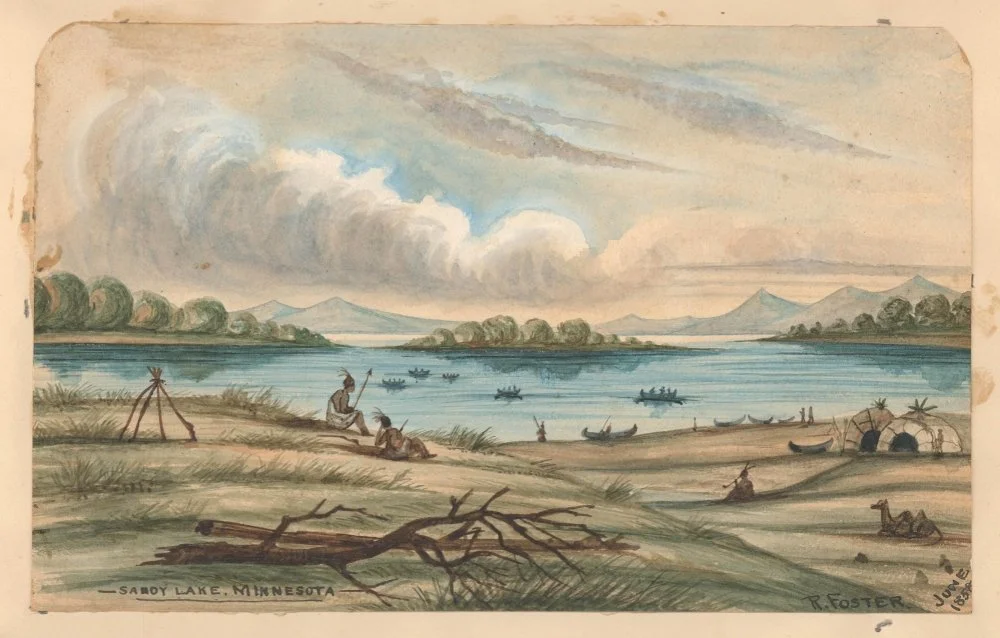
Sandy Lake, Minnesota, drawn in 1858. Sandy Lake was a major Ojibwe village located in what is now Aitkin County in northeast Minnesota
As Mike Spry writes (though please note that I change Margaret’s name back to MaChay when possible to both honor her true name + reduce confusion in my own post):
Sandy Lake was also the site of important trading posts during the fur trade era. In 1794 the Northwest Company established a post on the west shore of the lake that remained in operation until after the War of 1812. A law passed in 1816 required all trading with Indians be conducted by American citizens, which forced the Northwest Company to sell its holdings in the U.S. to John Jacob Astor.
The trading posts are important to our family’s story because it is likely that [MaChay] met [her husband] at one of these posts.
The interview noted that MaChay had been married to a man named Alexis Bles “13 or 14 years since” (which would be about 1825). Their union produced 5 children: Angelique, 11 years old; Antoine, 10 years old; Joseph, 8 years old; Edouard, 6 years old; & Alexander, 4 years old.
We do not have many clues as to who Alexis/Alexander was or where he came from. Mike found a record of an Alexander Blair who served in Canada in the British army during the War of 1812, so it’s possible that this Alexander stayed behind after the war and joined the then-booming fur trade. Most likely, Alexis/Alexander was one of the many French or French-Canadian fur traders or voyageurs who married an Ojibwe woman as a way to consolidate power and form potentially lucrative trading relationships on both sides. The state of these unions were varied…some women were forced into them by their tribes or families as part of trade agreements; others autonomously entered into them as one would a clever business partnership; and others were a love match, formed thanks to the proximity and growing familiarity of these two groups at trading posts.
While doing research for this chapter, I came across this book (which of course I was delighted to note is an American Girl book):
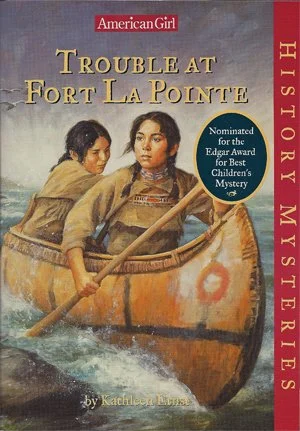
“Trouble at Fort La Pointe by Kathleen Ernst is a historical mystery for young readers, part of the American Girl History Mysteries series, set in 1732 on Lake Superior’s La Pointe Island. The story follows 12-year-old Suzette, who is of both Ojibwe and French heritage, as she tries to clear her father’s name after he’s accused of stealing valuable furs, which threatens to separate her family. Suzette must use her unique cultural knowledge to solve the mystery and allow her father to stay with his family year-round.”
Cool, right?! Also linking here to the story behind the story by the author, which also gives some fun and interesting historical context to what life was like at these posts.
Back to MaChay’s interview: It was noted that her son Antoine had been born at Mille Lacs and Joseph at Leech Lake, while the other three children were born at or near Sandy Lake. The interview also mentioned that Alexis had died “4 years since”, so around 1834-1835.
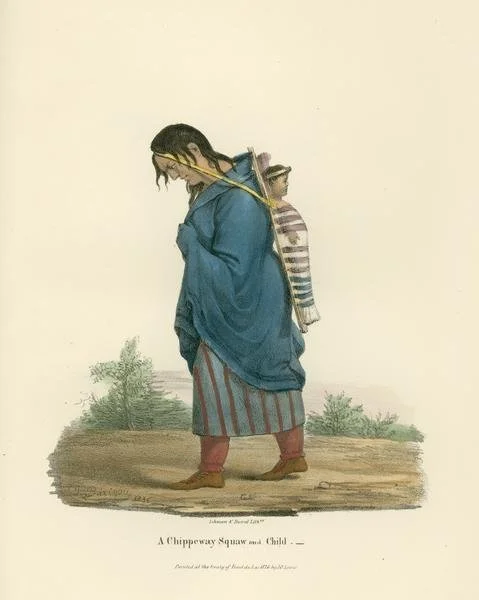
“Chippeway Woman & Child” a lithographed portrait painted by Charles Bird King, 1826-1837
From Mike Spry’s blog post:
The book also includes information about a man named Alexis Blais who appeared before the Indian agent in 1828. He was one of three men who were ordered out of Indian country the previous year because they did not have licenses to trade in Indian country. The men were summoned to Sault Ste. Marie by the agent, none other than Henry Rowe Schoolcraft, the “discoverer” of the Mississippi headwaters. The episode is documented in Schoolcraft’s “Personal Memoirs”, which includes parts of his daily journals. Schoolcraft wrote that Alexis “pleaded ignorance” to the laws pertaining to traders and Indian country. Schoolcraft’s journal implies that Alexis was the subject of a complaint by “Mr. Aikin” at Sandy Lake. That would be William Aitkin, the trader who ran the American Fur Company post there. During the interview, Alexis guessed that he would not have gotten in trouble if he had worked for Aitkin instead of independently. According to Schoolcraft, Alexis “did not desire to return to the Indian country”.
If Alexis Blais did leave the area in 1828, he would not have fathered MaChay’s younger children. In her interview at LaPointe MaChay claimed he died around 1835, which suggests he did not leave after meeting with Schoolcraft but returned to his family.
This experience has finally cleared up the mystery of who Alexis Blais (Alexander Blair) was and gives me a better picture of what life was like for MaChay and her children. It appears they moved wherever Alexis could make a living, with stops at Leech Lake and Mille Lacs. It is fascinating to know that our ancestors interacted with historic figures like Schoolcraft, Baraga and Aitkin.
Mooningwanekaaning was important to the family; MaChay and her children were baptized there by Father Baraga later in 1839 (documented in “All Our Relations”).
Here’s something we’ll be coming back to again and again…I was born in a tiny town called Halstad, which is riiiight on the Minnesota/North Dakota border and only 40 minutes north of Fargo. And yet, the journey of my life has unwittingly landed me in multiple places that I would only later discover I have deep ancestral connections to. When I was 19, my parents moved from Red Wing, MN - which will also come up in this context later - to a lake in the Chequamegon National Forest, outside of Cable, WI (home of Telemark and the original American Birkebeiner, which we will ALSO be talking about later in this context!). My parents’ lake home was about 45 minutes away from Bayfield/Madeline Island, which quickly became one of my favorite places to go after I moved up to that area, too (I would end up living in the Cable/Hayward area three times in my adult life). I literally had no idea that I had ancestors from there, much less deep tribal ancestors who, even after they were dispersed from the island to various reservations, still considered Mooningwanekaaning to be their spiritual home.
But I also love knowing that now, because having such a familiarity and love of that same place makes me feel even more connected to them.
The only other information we have about MaChay is that, according to Mike, she shows up in the “Half-Breed Scrip” report:
…which investigated the use of scrip to issue land claims under the 1854 Treaty. The investigating commission had as one of their sources a trader named Peter Roy, who claimed to know [MaChay]. Roy stated that she and her three children who filed claims for scrip in 1864 were from Sandy Lake and were mixed blood Ojibwe of Lake Superior. The commission ruled that [MaChay] was not eligible for scrip because she was married before 1854, and therefore was not a head of household when the treaty was signed.
Apparently, because [MaChay] was ineligible for scrip, the claims of her children were also rejected. Census records indicate that [MaChay] lived with one of her sons through at least 1870 and the sons and her daughter all settled together at Little Rock Lake north of present-day Sauk Rapids.
I just get so tired and angry when I read and learn things like the above. There is a part of me that really struggles when it comes to this part of our family’s history, because on a personal level I selfishly don’t want to contend with the facts of just how unfair and arduous it was for my ancestors to exist on the land that they loved and belonged to. And it’s doubly complicated to know that the pain and struggle that many of these ancestors endured was a direct consequence of the white settlers on other branches of my family tree.
But also, fck so much and so many members of the U.S government during this time.
Anyway!
Below is a lithographed portrait of Waembosehkaa, a chief from MaChay’s tribe, the Sandy Lake band. He was present - and painted by Charles Bird King - at the 1826 Treaty of Fond du Lac. I can’t find any reasonable estimation of how large the Sandy Lake band was during MaChay’s time (the only reputable fact I could dig up was that it was part of a larger group of over 5,500Ojibwe involved in regional treaty talks), but I do think it’s safe to assume that they knew each other; or at least she certainly knew of him.
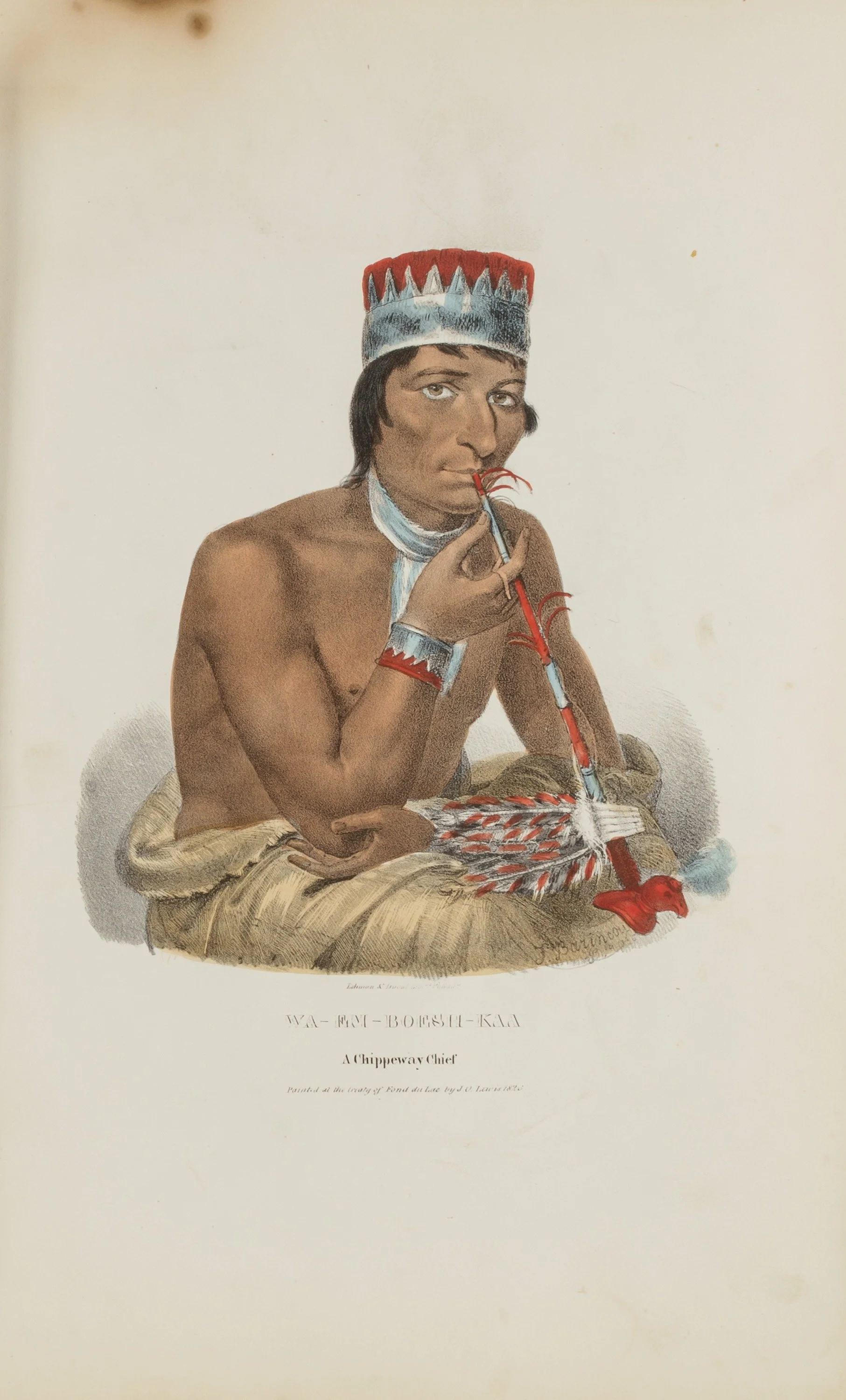
From History of the Indian Tribes of North America (1836–44), now part of the Smithsonian Institute and Royal Collection Trust. In other iterations there is red ceremonial/war paint over his eyes and the bridge of his nose, but this is the original portrait
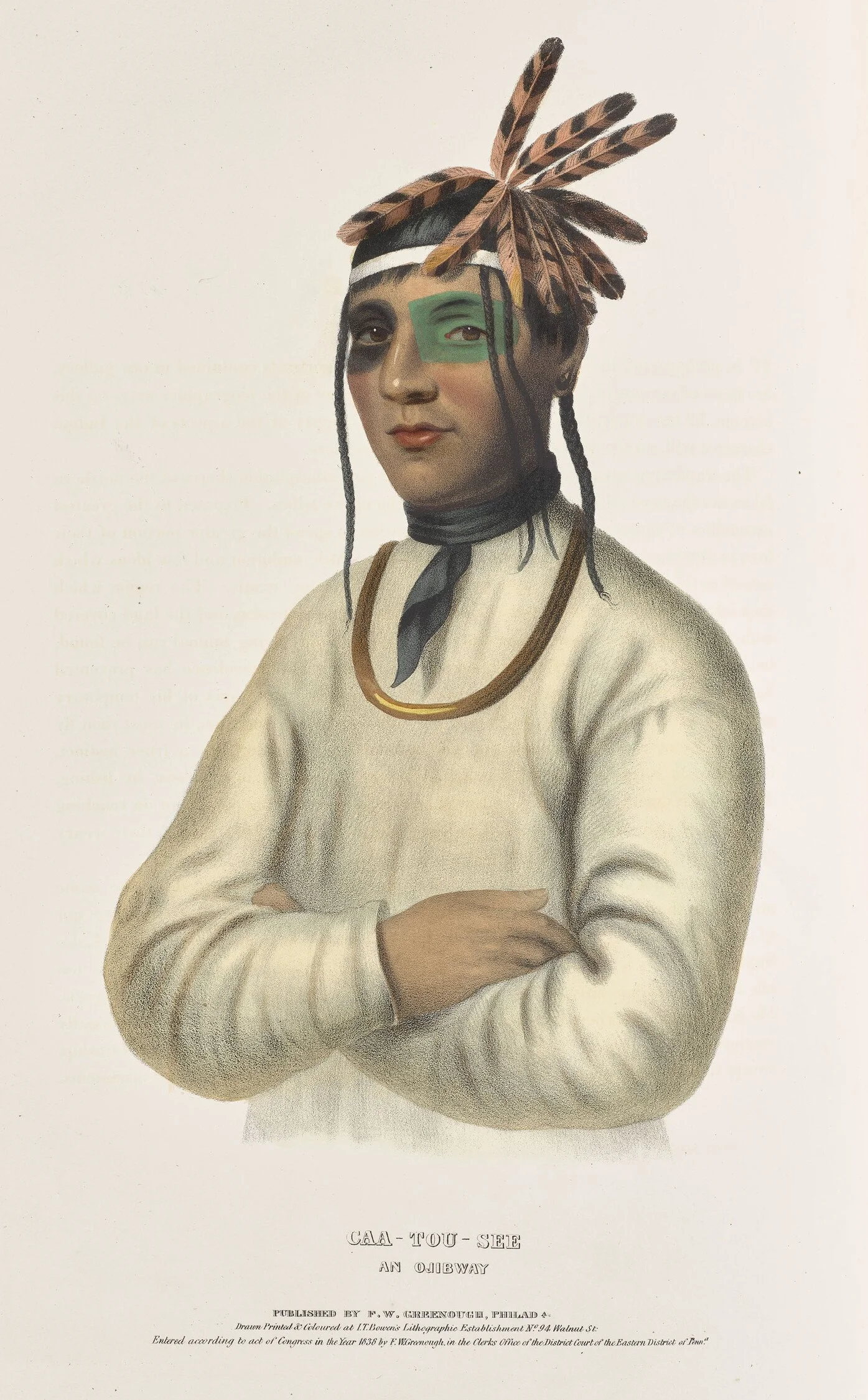
This is a lithograph from the same artist of Caatousee (“creeping out of the water”), an Ojibwe chief who was at La Pointe during the same time MaChay was living there with her children.
And then this portrait below…I was so struck by the features of the woman in this painting, but it was also a moment where you realize that you’ve been hoping to stumble upon some kind of resemblance, someone who absolutely has to be your ancestor. I wasn’t consciously assuming that MaChay might have been painted in these portraits, but I think deep down I was wishing to find one that felt illustrative of what she might have looked like during her life.
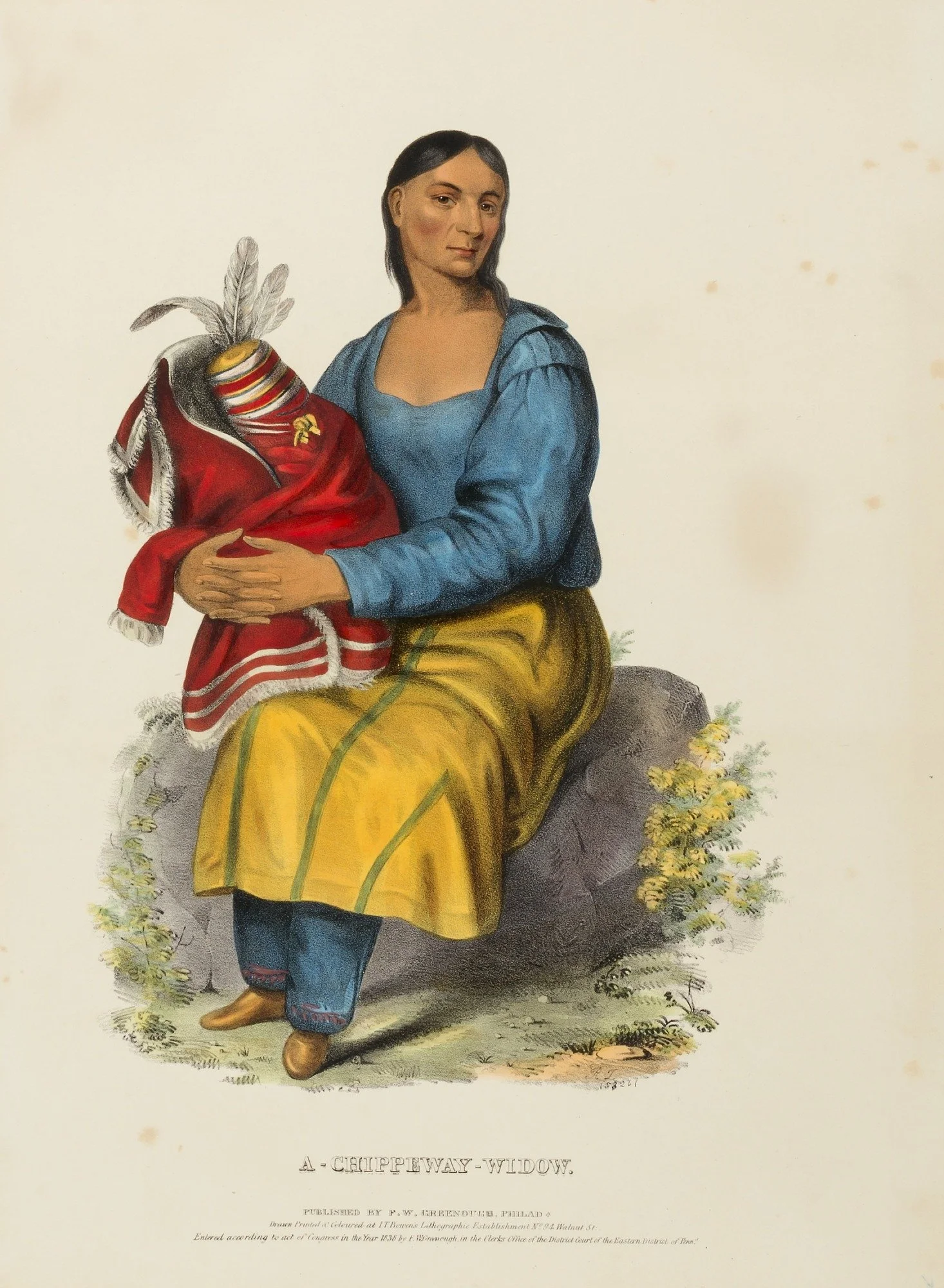
Here’s why I’m dumb: I kept going back to this portrait and looking at it again and again, and each time I would talk myself out of it being something that could represent MaChay. If I’m being honest, it was the sharp features…for some reason I was convinced that MaChay would have had a softer face.
But then the regularity with which I kept coming back to the portrait had started to feel the same way I felt when I was walking away from the Tower of London after touring it…I just kept turning back to look at it, again and again, until even my mom laughed and was like, “It’s like you’re getting in one last look at your home!” (which sent chills down my spine because when we were in a particular room inside of Tower grounds, I was stunned to realize that this was the exact room I had been in during vivid past-life memory that I’ve had since I was a child).
Then I remembered that I had a photo of Angeline as an elder, and that’s when I was like, “I am very smart but I am also very dumb because they literally have the same nose.” Maybe others won’t see it, and maybe I just really want to see it, but once you start comparing the sharp cheekbones, the angle of the brows, and the curve of the chin…this portrait literally could have been of Angeline when she was younger.
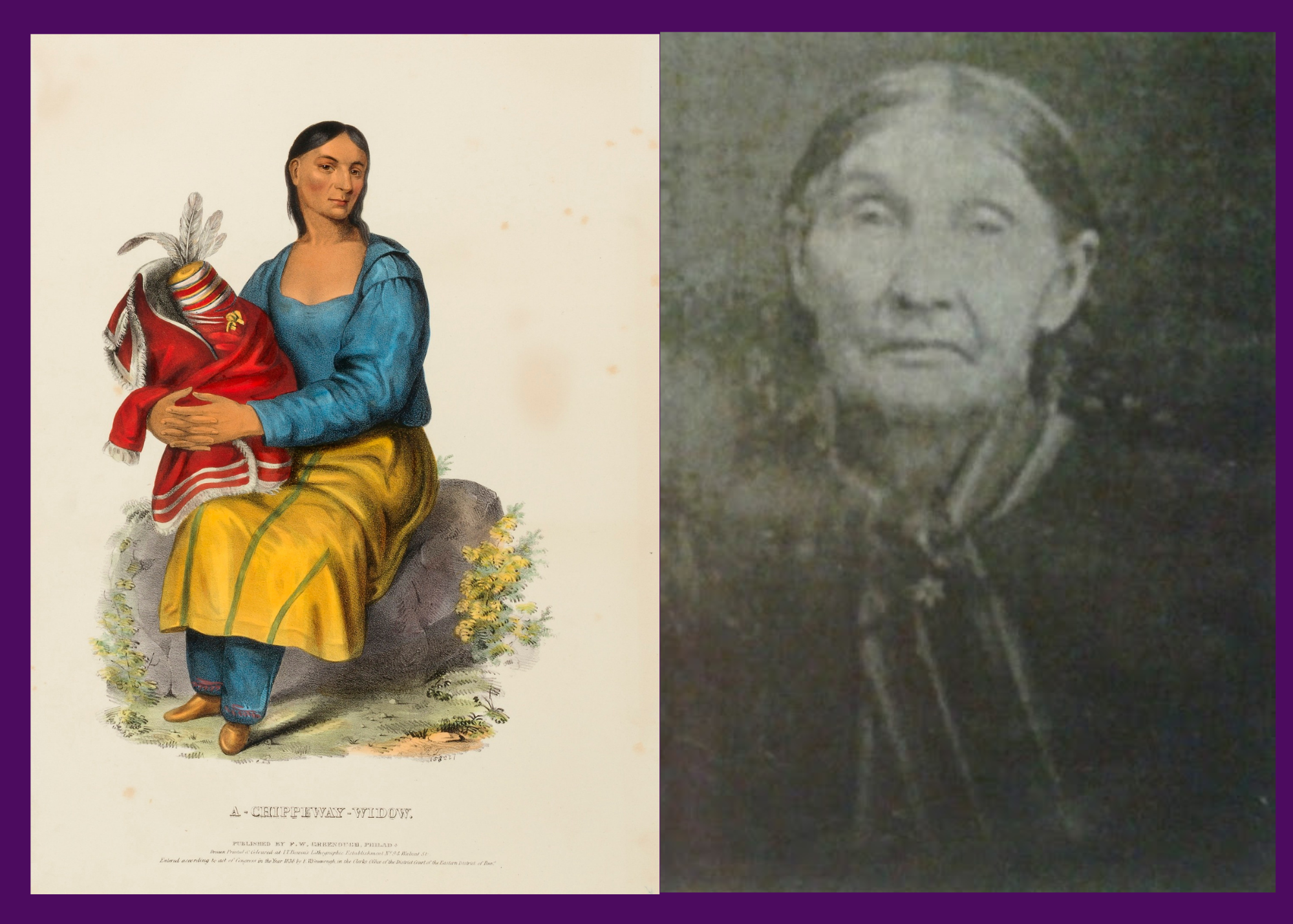
Again, I’m not saying the woman in the portrait is MaChay - also because I think the red coat and feathers she’s holding in the painting indicates her husband was Ojibwe, and MaChay’s husband was not - but (according to me) there’s definitely a strong familial/tribal resemblance, yeah?
Again, I’m gonna see what I wanna see and therefore am gonna need you to just go with me on this!
Anyway - speaking of Angeline, join me in the next chapter, where we’ll cover the many twists and turns of her historically notable life. ⭐️
Baamaapii,
- Amber